
You’ve got a binder, a tin, a shoebox, or a whole closet. You want to know two things: where to sell it, and what you’ll actually get. This is the honest version, for Miami, in September 2026.
The short answer
- A shop counter pays today, for the whole lot, and you watch it happen. Expect about half of market in cash, more in store credit. Best for most collections.
- An online buylist pays a similar credit rate but you ship, wait a week or two, and accept whatever condition grades come back.
- A marketplace (TCGplayer, eBay) nets the most per card — roughly 85 to 90 percent of market after fees — but only for cards worth listing, and only if you do the work.
- A card show is a counter with more competition and less time; fine for a few big cards, slow for a box.
- A local sale (Facebook, a friend) can pay full price or waste your weekend; it depends entirely on who shows up.
Most people do two of these: the top ten cards on a marketplace, the rest across a counter.
What each option actually pays
The number everyone argues about is “market.” It means what a card has sold for recently, in that condition — not what it’s listed at. Every option below is a share of that.
| Where | Typical share of market | Paid when | You do |
|---|---|---|---|
| Shop counter, cash | 40–60% (GH: 55%) | Same visit | Drive over |
| Shop counter, store credit | 55–70% (GH: 70%) | Same visit | Drive over |
| Online buylist, credit | 60–70% after their 30% bonus | 1–3 weeks | Sort, pack, ship, accept their grades |
| Marketplace listing | 85–90% after fees, shipping, returns | Whenever it sells | List, photograph, ship, handle disputes |
| Card show | 40–60%, sometimes better on one card | Same day | Table-hop, negotiate |
| Local sale | Anything | Whenever | Everything |
Two things hide inside that table. First, marketplaces charge around 11 to 13 percent in fees before shipping, and a card that doesn’t sell for three months was never worth 90 percent of anything. Second, a buylist’s “30% bonus” is on top of a cash rate that’s usually lower than a local counter’s, so the credit rates land in the same place — except the credit is only good on their website.
What Miami has
Miami is not short of card shops. There are counters in Kendall, North Miami Beach, Wynwood, Westchester and Doral, most of them good places to play and some of them buying. What the county hasn’t had is a shop that prints its rate before you drive — the national audit we ran found only one Florida shop stating any cash percentage at all, and none stating both cash and credit.
That’s the gap GH Games opens into: 55% of market in cash, 70% in store credit, on every card, on a sheet you keep. Bulk by the thousand at rates you can read on the Sell page. It’s the only printed two-rate schedule in the county, and the reason we can print it is that the pricing happens on your side of the counter.
What moves the number
- Condition. Near Mint pays the full rate; Lightly Played about 85% of it; Moderately Played 65%; Heavily Played 40%. The difference between NM and LP on a $200 card is $30 in your pocket, so don’t clean cards, don’t take them out of sleeves to check, and don’t stack loose holos.
- Set and version. A Base Set Charizard is a different card from a Base Set 2 Charizard, and 1st Edition, Shadowless and Unlimited are three different prices. Don’t guess — a good counter identifies them for you.
- Bulk versus singles. Commons, uncommons and the rares that trade for pennies are bulk, paid by the thousand. Everything else is a line on the sheet. Sorting your bulk by set and facing it the same way saves an hour of counting and gets you priced while you wait.
- Sealed. Unopened product from popular sets — 151, Evolving Skies, the Elite Trainer Boxes people hoarded — is often worth more than the cards inside it. Don’t open it to “see what’s in there.”
How to prepare
- Take one photo of the whole lot. A shop can tell from a single wide picture whether it’s worth your drive and give you a range. Ten close-ups tell them less.
- Pull the obvious hits. Anything holographic, anything with a texture, anything you remember paying for. Put them in one stack, sleeved. That’s your line list.
- Leave the bulk as it is. Don’t sleeve it; do sort it by set if you have twenty minutes.
- Bring ID. Florida requires a government photo ID for anyone selling to a shop, and you need to be 18 or have a parent with you.
- Decide cash or credit before you go, or take the sheet home and decide later — a printed offer is good for seven days.
What to expect at GH Games
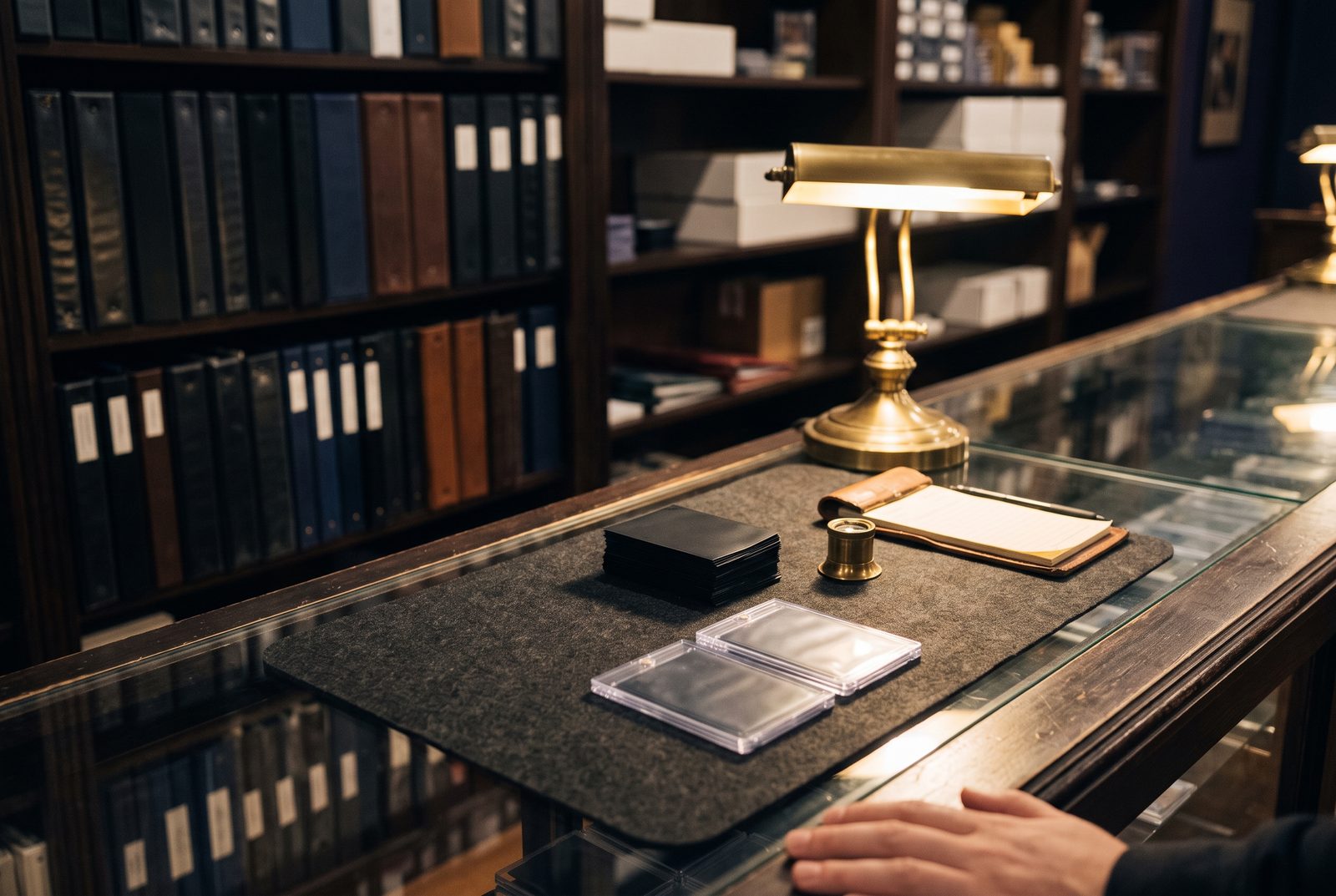
You put the box on the counter. Every card that isn’t bulk gets its own row: the card, the condition we graded it under the loupe in front of you, the recent-sales market price, and our offer at 55% or 70%. Bulk is counted while you watch and priced by the thousand. You leave with a sheet showing two totals, whether or not you sell.
Under two hundred singles is done while you wait. A real collection is priced within 48 hours. Send a photo first and we’ll tell you which.